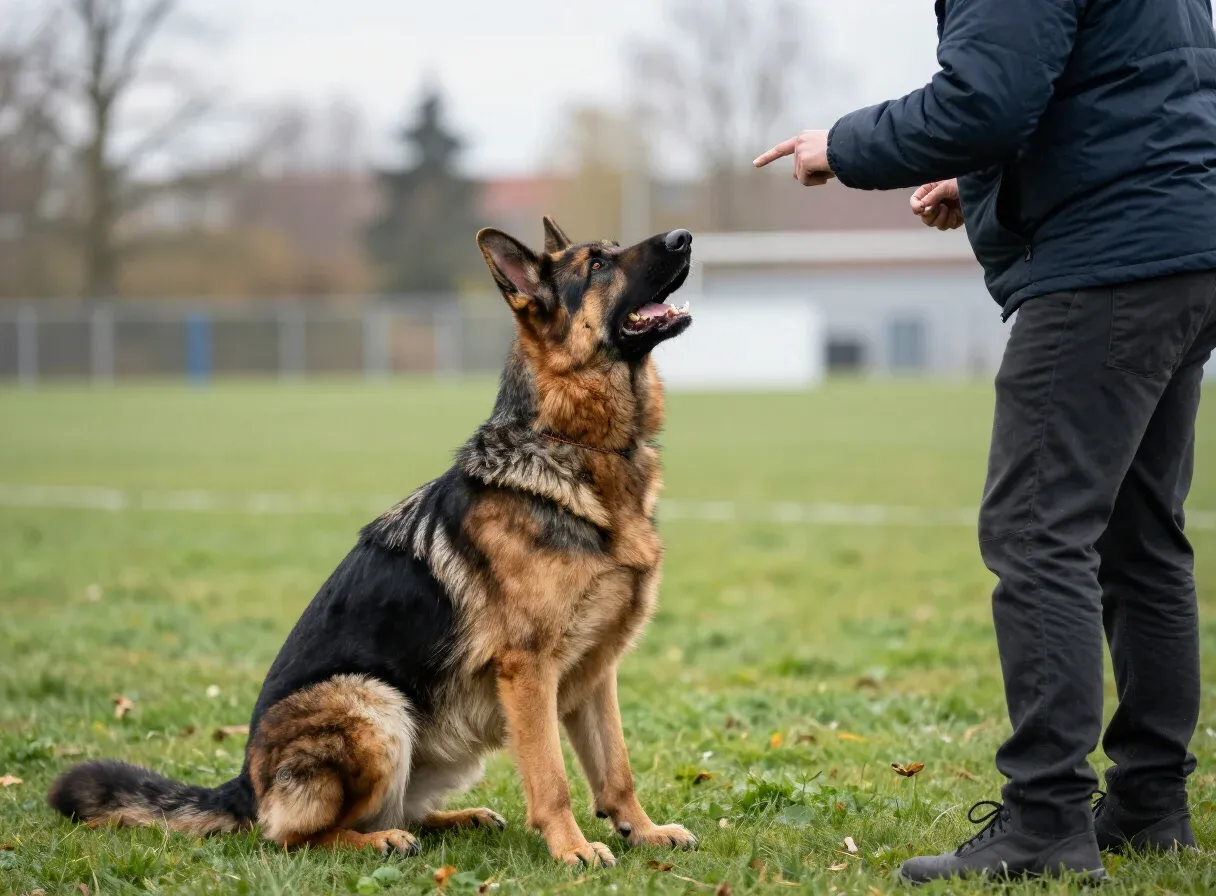
Between 8 and 18 months, many German Shepherds become more intense, independent, and easily distracted. For handlers, barking and lunging on lead can quickly become stressful. The goal is not to suppress every reaction, but to teach the dog how to remain under control when something exciting or worrying appears.
Find the Threshold
Start by identifying the distance at which your Shepherd can notice a trigger without immediately barking or lunging. This is your dog’s threshold.
If your dog is already exploding at the end of the lead, you are too close. Increase distance until your Shepherd can observe the trigger while still responding to you.
Reward Calm Responses
When your dog notices the trigger and remains calm, mark the behavior and reward immediately. You can also reward looking back at you, walking calmly, or choosing to disengage.
Keep sessions short and repeatable. The goal is to create many successful experiences rather than repeatedly exposing the dog until it reacts.
Increase Difficulty Gradually
As your Shepherd becomes more reliable, slowly reduce the distance or introduce slightly more challenging environments. Change only one variable at a time.
If barking or lunging suddenly increases, move farther away and allow the dog to settle before continuing.
Avoid punishment or forcing the dog closer to a trigger. These approaches can increase stress and make the reaction harder to manage.
With consistency, the adolescent Shepherd can learn that seeing a trigger does not automatically mean reacting to it.
Distance, calm repetition, and controlled progression are the foundation of reliable impulse control.